Every time I take my camera outside for a look at birds I get attacked by mosquitos, despite the application of insecticides.
The mozzies are prolific and aggressive and most annoying, so hopefully their numbers will settle down once summer is in full swing.
There were three hooded plover hatchlings between 10W and 11W on the beach. Despite warning signs and the area being roped off, some people allowed their off-lead dogs access to the area, which has resulted in the demise of the chicks. This is most disappointing and distressing.
Due to dune erosion between Collendina Beach and Point Lonsdale the hooded plovers are finding nesting difficult in that area, as the dunes are too steep. The dunes between 10W and 11W are appropriate for nesting, but the beach is not great as it’s the dog off-leash area. Thanks to all of the volunteers who try to help the hoodies. They do a wonderful job.
I visited some friends who live in the bush just out of Forrest in the Otways. I must thank my friend Pat for driving me, as my car managed to blow a head gasket last week, so I am now officially carless as it has gone to the wreckers.
I had a wonderful time wandering around the property in Forrest. It was quiet as far as seeing birds goes, as the property is surrounded by bush so there are many places for them to hide.
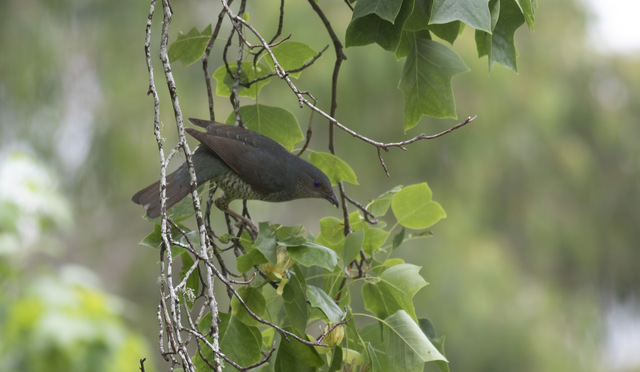
The weather was also quite hot which added to the lack of birds. I saw a pair of striated thornbills in one of the bird baths, plus two female satin bowerbirds, four crimson rosellas, two eastern spinebills and a few eastern yellow robins.
My friend told me that whenever they dig a hole in the garden or plough some soil, the eastern yellow robins virtually sit on their spades while they are digging to get to the insects in the soil.
They also told me that they mostly see female satin bowerbirds and hardly ever spot the male, which indicates to me that the bower must not be on their property, as the males tend to hang around the bower. However, when there is a blue bottle top or something similar in the garden, even if it’s in the house, the male bowerbird appears and sometimes bangs on the window trying to come inside to pick up the blue object.
Satin bowerbirds are renowned for decorating their bowers with all manner of blue objects collected from the area and sometimes from farther afield. These objects may comprise feathers from parrots, flowers, seed pods and fruits, butterfly wings and artificial items such as ball-point pens, matchboxes, string, pegs, marbles and glass shards.
Occasionally they use objects of different colours, especially green-yellow, if blue items are difficult to source. The male satin bowerbird carefully arranges the items around the bower to assist it to attract a mate.
Male satin bowerbirds are polygynous, which means they may mate with multiple female birds during the mating season.